Showing posts with label Calcium Sources. Show all posts

eHow Video: Taco Salad (and some words on craving the familiar)

     My mother is an excellent cook and one of my favorite dishes of all time was her taco salad. It was colorful and fun, and so delicious that I always had countless servings each time we had it for dinner. Her recipe called for ground chicken, so it's been quite a while since I've had it. For a long time, I avoided attempting to make vegan versions of non-vegan dishes I loved because I knew I would always prefer the original. This isn't because the original actually tastes better; it's simply because it's familiar. We humans are designed to be weary and skeptical of difference and change. There is no risk in sticking to the familiar; it's safer and more comfortable. BUT, if we give change a chance, if we can get out of our comfort zone just a little bit and give ourselves time to readjust, what was once unfamiliar will eventually become familiar. This applies to all aspects of life, not just food, so keep it in mind next time you find yourself making comparisons between the known and the unknown or feeling hesitant about trying something new.
     Anyway, since it has been quite a while since I've had my mom's taco salad and I knew I wouldn't have the attachment to its familiarity that I would have had years ago, I decided to give a vegan version of this recipe a go. Instead of ground chicken, I used ground tempeh, and I added corn in lieu of the shredded cheddar cheese she would sometimes add. Everything else was the exact same.
     Well, I was totally impressed with how it turned out! I'll just be blunt: it was spectacular. The ground tempeh was absolutely delicious. Which makes sense because, after all, I applied the exact same seasonings as she would with ground chicken. And as I always say, humans don't crave the taste of plain flesh; we crave the seasonings, and those seasonings are plant-based! I really liked the corn, too. I had added it mostly for color but it provided pops of delicious sweetness that went really well with all the lime juice and the salsa. I probably make this once a week because now it is so tasty. And just like before, my stomach seems to hold serving after serving after serving. Thank goodness!
(Serves 4--unless you are an extremely big eater--ahem--in which case it would serve 2-3)
Ingredients:
1 package tempeh, grated
1 large onion, chopped
2 1/2 cups of black beans (1-15 oz can + 1 cup)
1-2 tablespoons taco seasoning (I prefer 2 tablespoons)
2 heads of romaine lettuce, chopped
1/2 cup cilantro
1 cup of halved baby tomatoes
1 cup of sweet corn
1 cup of salsa
Lots and lots of limes!

Instructions:
1. Saute the onions and tempeh with a tablespoon of water until brown, about 10 minutes.
2. Add 1 can of black beans and the taco seasoning, and saute for another 5 minutes. Remove the pan from the heat and let cool until room temperature.
3. Place the romaine, cilantro and baby tomatoes into a large salad bowl. Add 1 cup of black beans, the corn, salsa, and tempeh mixture and toss. Serve with lots of lime wedges to squeeze just before serving. 

eHow video: Cream of Tomato & Navy Bean Soup

     Cream of tomato soup typically calls for a lot of butter and heavy cream. Many people assume that is what is needed to achieve a thick, smooth and creamy consistency. But unless one is looking to add saturated fat, cholesterol, and casein, then the dairy products simply aren't necessary.
     To achieve the soup's creamy consistency in my recipe, I use... you guessed it, beans! Navy beans, or any other white or light-colored beans, are great to use in lieu of dairy in creamy soups. And depending on how much creaminess you like, you can always add more or less beans.
     Navy beans are rich in protein (1 cup has 15 grams), and a great source of iron, folate, manganese, and calcium. And like all beans, navy beans add fiber to any meal (dairy has no fiber whatsoever), making this soup more filling and satisfying, as well as healthier for your heart. So next time you come across a soup recipe that calls for heavy cream, just remember there are so many reasons to use beans instead.
     This soup is truly bursting with flavor. The first time I tested it, I served it as an appetizer and it totally overshadowed the entree. It was also pretty filling for an appetizer so I have since served it as an entree with a big green salad and that hits the spot just right. I have never been a huge tomato soup lover, but I adore this soup. During the filming of this series, we were experiencing record-breaking low temperatures in Boston and the kitchen is the coldest part of our house. I didn't want to be in a huge puffy coat on camera but I was really freezing so as soon as we finished shooting this recipe, I just ate the entire batch by myself. I didn't even put it in a bowl; I just held the bottom of the pot with my oven-mittened hand and ate it straight from the ladle.  (It's really a miracle I didn't spill on my green shirt.) I'm sure the camera man thought I was crazy but I felt so much better. Like I said, this soup really hits the spot.
Serves 2-3
Ingredients:
1-15 oz can navy beans (or 1 1/2 cups)
1-15 oz can crushed tomatoes
1 bay leaf
1 large carrot
1 celery stalk
1 clove garlic
1 teaspoon cumin
1 tsp smoked paprika
2 tablespoons dried basil
1 dash cayenne
1 cup tomato puree
1/2 tablespoon reduced-sodium tamari
1 date
2 tablespoons tomato paste
1/4 cup chopped fresh basil, as garnish (optional)

Instructions:
1. In a soup pot, combine the navy beans, 3 cups of water, crushed tomatoes and bay leaf. Bring to a boil, and cover and simmer.
2. Meanwhile, dice the carrot, celery and garlic. Add the garlic to a saute pan and cook for 2-3 minutes. Then add the celery and carrots, and saute for another 5 minutes.
3. Add the cumin, smoked paprika, basil and cayenne to the saute pan and stir for 2 minutes.
4. Add the tomato puree to the saute pan. Turn up the heat to medium-high, and cook for another 5 minutes.
5. Add the saute mixture to the soup pot and bring to a boil. Reduce to a simmer and cover for 30 minutes or until the vegetables are tender.
6. Remove the bayleaf. In a food processor or blender, add the tamari, date, tomato paste and soup (in batches if necessary). Blend to desired consistency. Serve with chopped fresh basil, if using.

eHow Video: Down-South Homemade Chili (a.k.a. Chili Jambalaya)

     What is a series on beans without a chili recipe? Rather than sharing a more Western-style chili with black beans, tomatoes, and Mexican seasonings, I thought it would be a fun opportunity to move East and make something with more of a Southern vibe. The result is a mix between a chili and a jambalaya with ingredients found in traditional dishes all across the South, from Cajun spices to black-eyed peas to okra. I am proud of all the recipes in this series but I am especially proud of this one. I even had the chutzpa to make it for my Southern in-laws, knowing full well I was encroaching on dangerous territory (not being a Southerner myself and all), and it received excellent reviews.
    This has truly become a favorite meal in our house. It's also great leftover. I like making a big batch for dinner on Sunday night and then packing the rest for Mr. Goldhouse's lunch for the next several days. And, of course, it's incredibly healthful, as kidney beans and black-eyed are both excellent sources of protein, fiber, calcium and iron. 


Ingredients:
Cajun spice blend:
2 teaspoons smoked paprika
2 teaspoons thyme
1 teaspoon oregano
1 teaspoon marjoram
1/2 teaspoon cayenne pepper
1/2 teaspoon onion powder
1/2 teaspoon garlic powder
1/4 teaspoon allspice
1/4 teaspoon ground cloves
.....
1 onion, chopped
2 stalks celery, chopped
4 cloves garlic, minced
1 bell pepper, diced
1 1/2 cups brown rice
1 package frozen okra, de-thawed
2-15 oz can kidney beans (3 cups)
1-15 oz can black-eyed peas (1 1/2 cups)
1-15 oz can corn (1 1/2 cups)
1/2 teaspoon liquid smoke
3 cups vegetable broth

Instructions:
1. Prepare the Cajun spice blend and set aside. (Tip: I like to double this and store what I don't use for this recipe in a plastic baggy. That way it's all set to go next time I need it.)
2. In a soup pot, saute the onion, celery, garlic and pepper in a tablespoon of water for about 10 minutes, or until the onions are translucent. 
3. Add the remaining ingredients and 1 1/2 tablespoons of the Cajun spice blend.
4. Turn the heat to medium-high and bring to a boil, and then reduce to low and cover. Cook for about 40-45 minutes, or until the rice is done. Stir every 20 minutes and add more liquid if necessary.
5. Once the rice is ready, season with salt, pepper, and more Cajun seasoning as needed.

eHow Video: Dry Roasted Soybeans & Some Words on Soy Myths

     We all know that beans make a great dip or a great chili, but did you know they also make a great snack?
     You really could us apply this recipe to any type of bean but I think soybeans are just the perfect size and, frankly, this recipe really  hits the spot so I'm not too inclined to mess with it.
     Many roasted bean recipes will say olive oil is necessary to get the spices to stick onto the beans, but I find they spices stick just fine if the beans are wet, so I just add the spices right after I rinse the beans. This recipe calls for 1/2 teaspoon salt, which, if you are snacking with others, is pretty moderate but you are certainly free to use less or omit it entirely if you are on a low-sodium diet.
    Soybeans are incredibly nutritious. In fact, according to a recent research analysis, if Americans replaced their meat and dairy intake with soy, they would increase they intake of calcium, magnesium, iron, vitamin K, folate and fiber. But despite the plethora of scientific evidence about the health benefits of soy, there is still a lot of misinformation that continues to get passed around. I have heard some pretty extreme claims, everything from "I avoid soy because it causes dementia" to "Soy causes breast cancer" to "I don't let my son have soy because it will turn him into a girl." We've all heard claims like this, or perhaps we've even been the one doing the speaking. When we absorb or pass on these claims we are buying into and perpetuating a multimillion dollar anti-soy campaign sponsored by the meat and dairy industry.
     So here are some important myths about soy I wanted to debunk right off the bat to put your mind at ease.

Myth: "Soy causes dementia."
Reality: Soy does not cause dementia; in fact, it improves cognition. This myth seemed to originate from a study in which researchers found that tofu had harmful cognitive effects on people in Indonesia. However, the same was not true for tempeh, which is a more concentrated source of soy, so clearly soy itself was not the problem but something that was being added to the tofu. Well, guess what they use a preservative for tofu in Indonesia? Formaldedye! Yep, the same flammable human carcinogen that's used to make home industrial products. So next time someone tells you soy causes dementia, set the record straight and say that formaldedye might but soy certainly does not.
More info:
http://nutritionfacts.org/video/does-tofu-cause-dementia/

Myth: "Soy causes breast cancer."
Reality: This myth stems from the belief that soy has estrogen, and higher levels of estrogen have been linked to breast cancer. But soy doesn't even have estrogen! It has something called phytoestrogen, but this is not estrogen. Estrogen is a sex hormone that is found in all animals (including humans). Soy, in fact, is actually protective against breast cancer. It has been shown to reduce both the recurrence of and the risk of death from breast cancer.
More info:
http://nutritionfacts.org/video/brca-breast-cancer-genes-and-soy/
http://nutritionfacts.org/video/breast-cancer-survival-and-soy/
http://nutritionfacts.org/video/soy-breast-cancer-3/

Myth: "Soy gives men "man boobs."
Reality: Again, this probably stems from the confusion between estrogen and phytoestrogen. Soy has been shown to have no effect on a man's testosterone levels or circulating estrogen levels whatsoever. Also, if you are concerned about getting too much estrogen from soy but are still drinking breast milk from a 1,500 lb cow, I think you are barking up the wrong tree. Cows, like humans, only produce breast milk after giving birth. The demand for dairy means that a cow is essentially always pregnant so that she will always be producing milk. So those who consume dairy are consuming the milk from pregnant cows, which have a whole lot of estrogen. In fact, people who consume meat and dairy have significantly higher levels of estrogen in their blood. Definitely check out this study which examined what happens to men's hormone levels within in just one hour of consuming dairy (hint: their estrogen levels went up and their testosterone levels went down!).
More info:
http://www.fertstert.org/article/S0015-0282(10)00368-7

Myth: "All soy is GMO so it's poison." (I've actually heard this one verbatim.)
Reality: First of all, the largest consumer of GMO soy is farmed animals. In her article, "A Vegan Doctor Addresses Soy Myths and Misinformation", Holly Wilson, M.D. explains that this GMO soy "does not just magically evaporate in the slaughterhouse or milk processing plant. It ends up on your plate." Secondly, numerous brands of non-GMO tofu, tempeh, soy milk, and soy beans can be found in your grocery store labeled clearly on the package. These include Silk, Morinaga, and many others (see a comprehensive list here).

For more information debunking the misinformation about soy, read "Being Vegan and Eating Soy: Myths, Truths, and Everything In Between" by Christa Novelli M.P.H.
   
    So please, let yourself relax about soy and enjoy this delicious and healthful snack without a worry in the world. These crunchy and crispy little beans are so much fun to pop into your mouth. Be warned: they are quite addictive!
Ingredients:
2 cans of soybeans, drained and rinsed.
1 teaspoon chili powder
1 teaspoon cumin
1/2 teaspoon salt (optional)
1/2 teaspoon allspice
1/4 teaspoon cayenne

Instructions:
1. Preheat the oven to 400 degrees. In a medium bowl, toss the spices with the soybeans until evenly coated.
2. Spread the soybeans in one layer onto a tinfoil-lined baking sheet.
3. Roast the soybeans for 45-60 minutes, stirring every 20 minutes so they cook evenly.

eHow Video: "Southern-Style Mustard Greens"

     Mustard greens are so incredibly healthful, it was hard to decide which of their many benefits I ought to focus on in this post. Here are just three reasons why you'll want to incorporate more of these luscious leafies into your diet:

Cardiovascular Benefits
    Mustard greens support the cardiovascular system in three significant ways. First, they are anti-inflammatory. Inflammation narrows the arteries and increases the risk that they'll become blocked, so these anti-inflammatory properties are obviously a huge benefit. Second, by binding with bile acids in the intestines, mustard greens help lower cholesterol levels. And third, because mustard greens are exceptionally high in the B-vitamin folate, they help prevent homocystein build-up. Homocystein is an amino acid found in the blood that is acquired mostly from eating animal products. High levels are related to the development of heart and blood vessel disease.

Cancer Prevention
     Mustard greens are also powerful cancer-fighters because they are LOADED with a broad spectrum of antioxidants. Chronic oxidative stress is a major risk factor for the development of most cancer types and antioxidants lower our risk of oxidative stress on our cells (hence the name: anti- oxidants). For the record, plants have on average 64 times more antioxidant power than animal products. The few antioxidants that do happen to be found in animal products are only there because those animals were fed plants.

Bone Health
     And lastly (though I truly could go on endlessly), mustard greens are an excellent source of calcium. While dairy products have long been touted as "good for your bones," the countries with the highest consumption of dairy also have the highest rates of osteoporosis. This is because dairy, like all animal products, is highly acidic. The body needs to keep a very specific acid-alkaline balance in order to function, so whenever animal products are consumed, the body must find an alkaline source so it leaches the calcium from our bones (which is high in alkaline). So, in fact, consuming dairy products are quite harmful to our bones. Mustard greens, on the other hand, along with other greens like kale, collards, bok choy, broccoli, and okra, are not acidic and thus only contribute to the strength of our bones.

     So while you enjoy this quick and tasty recipe, you can also feel good knowing that you are eating one of the most healthful foods on the planet!

Ingredients:
1 large bunch mustard greens, chopped
1 small onion, chopped
3-6 cloves garlic (depending on your garlic preferences), chopped
1 teaspoon smoked paprika
1 teaspoon salt (optional)
1 teaspoon black pepper
1/4 cup water

Instructions:
1. In a cast iron pot, saute the onion until soft.
2. Add the garlic, smoked paprika, salt and pepper. Cook for 1 more minute, stirring constantly.
3. Add the mustard greens, and stir until they are coated with the spices and just wilted.
4. Add 1/4 cup of water and let simmer, covered, for about 5 minutes. Remove cover and cook for another 1-2 minutes.

Resources:
http://www.whfoods.com/genpage.php?tname=foodspice&dbid=93
http://www.vrg.org/nutrition/calcium.php
http://www.pcrm.org/health/health-topics/calcium-and-strong-bones

eHow video: "Coconut Milk Tofu Quiche with Onions and Mushrooms"

     People often complain that they don't have time to make dinner every night. Well, guess what? I don't make dinner every night! That's right. And yet we never get take out, rarely dine out, and my husband always has a packed lunch to take to work.
     How is this possible? Ladies and gentlemen, let me give you a life-saving tip: Make dishes in large enough portions that they will cover the next few days' meals and/or can be frozen and eaten at another time. That, my friends, is how you can eat healthfully every night without having to spend all your time slaving away in the kitchen. It's that simple!
     This quiche is a perfect example of a dish that will last for multiple meals. Plus, it's one of those special dishes that can be enjoyed at any time of day. I love preparing it for dinner and then enjoying it again the next day for breakfast and packing it up for my husband for lunch for the next few days. Because both the crust and the filling contain herbs, each bite is wonderfully aromatic and richly flavorful. Enjoy!

Crust Ingredients:
2 1/2 cups almond meal
1/4 cup water
1 1/2 tablespoons fresh rosemary, finely chopped
1 teaspoon salt

Filling Ingredients:
2 1/2 cups cremini mushrooms, sliced
1 large yellow onion, thinly sliced
2 tablespoons balsamic vinegar
2 packages firm silken tofu
1/4 cup coconut milk (or any other nondairy milk)
3 tablespoons nutritional yeast
3 teaspoons of your favorite herbs (i.e. basil, thyme, sage, oregano, etc.)
1/2 teaspoon salt

Crust Instructions:
1. Preheat the oven to 375. In a medium bowl, combine the almond meal, salt, and rosemary. Add the water and stir until fully combined.
2. Gently press the dough evenly against the bottom and sides of a pie pan. Bake for 10 minutes or until the crust looks dry and just toasted.

Filling Instructions:
1. Slice the tofu and wrap in a few layers of paper towels to drain out the excess moisture. Set aside.
2. Saute the onions and mushrooms in balsamic vinegar until the onions are caramelized, about 10 minutes.
3. In a food processor or blender, mix the tofu, nutritional yeast, nondairy milk, and herbs till smooth.
4. Combine the tofu mixture with the sauteed mushrooms and onions and stir till fully mixed.
5. Pour the filling into the pie crust and bake for 30-40 minutes, or until the top is golden brown. Remove and let cool.

My eHow Video Series: Crescent Spinach Dip

      Have you ever looked up the ingredients in traditional spinach dip? You'll find things like butter, mayo, heavy cream, and dairy cheese. It's not really fair to call it "spinach" dip. "Saturated fat" dip would be more accurate.
     The really sad thing is that none of these unhealthful ingredients are necessary for making a fantastic dip. We just include them because we always have. But just because we always have done something doesn't mean we always have to keep doing it. We need not be slaves to custom or tradition or habit. I think most people would agree that custom, tradition, or habit aren't good enough reasons to continue causing harm to ourselves or others, ESPECIALLY when there are quick and easy alternatives out there.
    My version of spinach dip takes the spinach seriously. And, in addition to using a whole package of thawed frozen spinach, I also use a whole head of kale. Like spinach, kale is loaded with vitamins A, C, K and folic acid, and it's also a rich source of calcium and iron. Kale also contains carotenoids, which are potent antioxidants with natural inflammatory properties that help prevent some cancers.
     I use cashews to add a rich creaminess that we too often mistakenly think we can only get from dairy products. Plus, cashews have numerous health benefits. They are high in copper which helps defend against iron deficiency anemia, ruptured blood vessels, osteoporosis, joint problems such as rheumatoid arthritis, elevated LDL cholesterol and reduced HDL cholesterol levels, and irregular heartbeat. Because of their high antioxidant levels, nuts like cashews have been linked to lower risks of cardiovascular and coronary heart disease. For additional creaminess, I use beans, which also adds protein and even more fiber to this already fiber-rich dip. (For more on the wonderful world of beans, see here.)
    
     This is one of my favorite dishes in this whole series. I love this recipe because it demonstrates that you can eat in a way that reflects your deepest values of health and compassion AND feel like you've died and gone to heaven because it tastes so good. For me, the beauty of being vegan is that we can have both!

Ingredients:
16 oz. organic frozen spinach, thawed
1 bunch kale, chopped
1/2 cup raw parsley

1 cup raw cashews, soaked in warm water about 20 minutes
3 cloves of garlic
1/4 cup lemon juice
2 Tbsp apple cider vinegar
1 tsp sea salt

5 Tbsp Nutritional Yeast Flakes

1 can cannellini beans

Instructions:
1. Add all your ingredients (except beans and cheese) to a food processor or blender. Blend until smooth.
2. Pulse in the beans.
3. Pour spinach dip into a heat-safe serving dish. Add the cheese on top and place in a 350 degree oven for 15 min.
4. Serve warm with veggie sticks, bread squares and rice crackers.

My eHow Video Series: Dip for Sweet Peppers (Triple 'S' Dip)

     This dip is a guaranteed hit at any social gathering; people just can't seem to get enough of it! Eating it with sweet peppers is not only tasty, but also incredibly healthful since bell peppers are good for our hearts, our immune systems, our eyes, and our skin.
     As I mention in the video, I call this dip the "Triple 'S' Dip" because it's salty, spicy, and sweet. Unfortunately, the part where I add the sweetness-- 2 tablespoons of maple syrup-- was mistakenly cut from the video. Be sure to add that in to get the full mouthwatering trifecta of flavor.
Ingredients:
1/2 cup almond butter (or peanut butter)
3 tablespoons tahini
1/4 cup tamari (or soy sauce)
2 tablespoon maple syrup
1 tablespoon apple cider vinegar
2 cloves garlic
1 tablespoon fresh ginger
1/4 teaspoon cayenne pepper
1/3 cup water

Instructions:
1. Blend all the ingredients together and blend till smooth.
2. Serve with bell peppers.

My eHow Video Series: Sesame Eggplant Dip Recipe

     In this video, I demonstrate my recipe for baba ghanouj, a Middle Eastern dish made with roasted eggplant and tahini. I am a huge eggplant fan, so baba ghanouj is naturally one of my favorite dishes in the world. If you like the flavor of hummus, you'll most likely love baba ghanouj. It's basically hummus's more exotic and dramatic big sister. Like hummus, there's lots of garlic, creaminess from tahini (sesame paste), earthy spices, and usually lots of olive oil.
      In my recipe, I omit the olive oil and rely on the tahini alone to provide the fat and butteriness, and you'll see it does the job just fine. I also leave the skin of the eggplant on, which is not typical of most baba ghanouj recipes, unfortunately. Eggplant skin is rich in nasunin, a potent antioxidant that protects cell membranes from damage.
     You can enjoy baba ghanouj with pita, veggies, spread on a sandwich or just by itself. Watch and I think you'll find it becomes a favorite of yours, too.
Ingredients:
1 large eggplants (totaling 2 lbs)
2-3 tablespoons roasted tahini (sesame paste)
1-2 garlic cloves, finely chopped
1 teaspoon ground cumin
2 ½ tablespoons lemon juice
Salt and cayenne pepper to taste
1 tablespoons chopped parsley 

Instructions:
1. Preheat oven to 400°F. Poke the eggplants in several places with a fork. Cut the eggplants in half lengthwise and place on a baking sheet, cut side down, and roast until very tender, about 35-40 minutes.
2. Remove from oven and allow to cool for 15 minutes.
3. Remove the eggplant skin and scoop flesh into a large bowl and mash well with a fork.
4. Combine the eggplant, minced garlic, tahini, garlic, cumin, lemon juice, the salt, and a pinch of cayenne. Mash well. You want the mixture to be somewhat smooth but still retaining some of the eggplant's texture.
5. Allow the baba ghanouj to cool to room temperature, then season to taste with additional lemon juice, salt, and cayenne. If you want, swirl a little olive oil on the top. Sprinkle with fresh chopped parsley. Serve with pita bread, crackers, toast, sliced baguette, celery, or cucumber slices.

Babies and Milk

    Some of my students express anxiety about becoming deficient in certain nutrients once they switch to a plant-based diet. All of us, of course, should always be concerned with getting sufficient nutrients, but it's funny that these fears seem to appear only after a person has eliminated animal products. Those around us bolster these fears too. Tell someone you are vegan and the first thing you'll be asked is where do you get your x, y or z. Tell someone you eat animals and no one is concerned (which is unfortunate because the vast majority of non-vegans do not consume nearly enough nutrients like fiber, phytochemicals, and antioxidants which, of course, can only be found in plants). The implication is that only when we go vegan do we need to be concerned with deficiency.
      This is just silly. We all need to remember that there is nothing magical about flesh or dairy. They don't contain unique properties that cannot be found elsewhere. No one, at any stage of life, needs to consume them. Period. Human beings don't require specific ingredients; we require specific nutrients. And again, neither flesh nor dairy contains required nutrients that cannot be found elsewhere.
     When kids enter the picture, this anxiety only grows both within us and from the world around us, including from doctors (which is particularly infuriating). I recently received the following inquiry from a friend: "I feel so 'obligated' to give my 1 year old whole milk because it's so ingrained in my brain, but please let me know if you have any good  sources of information on feeding babies soy and/or almond milk. I asked my son's doctor, and she said to stick with whole milk. Her reasoning wasn't very convincing though (as much as I hate to second guess her judgement)."
      Stories like this make me want to pull my hair out. 
      First of all, I need to remind people that doctors receive almost no nutrition training in medical school. I know that sounds absurd, but unfortunately, it's true. The advice you'll get from most doctors isn't worth that much more than the advice you would get from asking Joe Schmo on the street. Often times doctors will just tell their patients to do what they themselves have always done or what their parents always did. In other words, when it comes to nutrition, the advice doctors give is usually based on their own habits rather than on science. After all, doctors used to advocate smoking cigarettes to patients because they smoked cigarettes themselves!
      So, do toddlers need to consume cow's milk? The answer is NO. 
      In previous posts, I've discussed why dairy is harmful, but here's a quick recap: Recent scientific studies have suggested that dairy products may be linked to increased risk for prostate cancer, testicular cancer, and possibly for ovarian and breast cancers. And despite the widespread myth that dairy milk is good for your bones, it has actually been singled out as the biggest cause of osteoporosis. Dairy is also high in cholesterol and saturated fat, which leads to heart disease. And over 75% of people on this planet are genetically unable to digest dairy, yet we label this near universal human trait "lactose intolerance" as if it were some disease or deficiency. Here's the reality: Human babies are born with an enzyme that allows us to digest our mother's milk. Between the ages of two and five, the vast majority of humans lose this enzyme because we are supposed to be weaned by then. Our bodies simply weren't designed to be consuming milk into adulthood (let alone the breast milk of another species!). This is why so many babies and toddlers who are fed cow's milk suffer from digestive upset. Nothing is wrong with them; it's what they are being fed!
      So why do so many pediatricians recommend feeding human babies whole cow's milk? 
      Whole cow's milk is a go-to for parents and pediatricians simply an easily accessible source of fat, calcium, and vitamin D that is readily available in supermarkets. That's it. Again, there is nothing magical about cow's milk for humans, whole or otherwise. 
     Fortunately, there are an increasing number of doctors who are starting to wake up to the nutrition science. In fact, in 2008 and 2011 the American Academy of Pediatrics published releases that discouraged the transition to whole cow's milk because of the increased risk of cardiovascular disease. In "Disease-Proof Your Child" (which I highly recommend!), Dr. Joel Fuhrman advises against cow's milk because it can create gastroesophageal reflux, iron deficiency, and calcium sodium excess in infants and toddlers. It also lacks DHA, a necessary ingredient for brain development. And Pediatrician Dr. Natasha Burgurt explains that "unlike the dietary needs of an infant, milk is no longer a source of complete nutrition after a child's first birthday. Milk provides a convenient source of fat, protein, calcium, and vitamin D for growing bodes. But, in today's average food lifestyle, these building blocks can be more than adequately supplied in other areas of a balanced diet." In other words, toddlers can get their nutrients from food, rather than a beverage. In fact, Dr. Burgurt argues that this is preferable. "In a society that typically drinks too many unnecessary calories," she says, "it is preferred that children develop a preference for low-fat, low-calorie, unsweetened beverages." 
     The bottom line is that toddlers don't need cow's milk. What toddlers do need are specific nutrients. In "Becoming Vegan" (a must-have book on nutrition), Brenda Davis, RD and Vesanto Melina, MS, RD recommend breastfeeding a baby for a minimum of one year and preferably for a full two years or more. If you decide to stop breastfeeding (or using formula), "during the 12-24 month period, fortified soymilk is your best alternative. It should contain calcium, vitamin B12, and vitamin D." They also recommend including plenty of higher-fat foods in a toddler's diet. Some examples of foods that provide these important sources of fat include tofu, smooth nut butters, mashed avocado, soy yogurt, puddings, and moderate amounts of olive, canola, and flax oil. Omega-3 fatty acids can be found in dark green leafy vegetables, seaweeds (which are the the original source for fish), selected seeds (flax, chia, hemp), nuts (walnuts, butternuts), and soybeans. Calcium-rich foods for toddlers include breast milk, commercial soy formula, or full-fat fortified soymilk. Food sources of vitamin B12 include nutritional yeast, fortified soy and grain milks (such as Edensoy Extra, Silk, Soy Dream, Rice Dream, So Nice, and Vitasoy Enriched), fortified breakfast cereals (such as Raisin Bran, Kelloggs Cornflakes, Grapenuts, Nutrigrain, and Total). Vitamin D--which does not exist naturally in cow's milk; it's only there because it has been fortified--can also be found in other fortified foods, including nondairy milks, or from sufficient sun exposure. 
     Reed Mangles, PhD, RD provides the following chart on the Vegetarian Resource Group (as well as in her nutrition book, Simply Vegan):
       No one wants to give their child a beverage linked to so many health problems, and I believe that deep down we all care about the mothers and babies of other species and don't want to cause them harm if we don't have to. For all of you with a little one in your life, I hope this information gives you the confidence to feed your children healthfully and compassionately :)

Below are some links I found from vegan moms raising vegan toddlers that may be helpful:

Disease Prevention for Breakfast


    Google image search "American breakfast" and you'll see a pretty sorry state of affairs. You'll see bacon strips, scrambled eggs, fried eggs, sausage, fried hash browns, fried ham, pancakes with butter, waffles with butter, toast with butter, buttered croissants, bagels with cream cheese... you get the idea. Google image search "healthy american breakfast" and you'll see practically the same thing. You'll get a couple more shots of orange juice (which by definition has been entirely striped of fiber) and some shots of highly refined cereal floating in bowls of dairy milk, but essentially the same thing. No greens, almost no fresh fruit, and A LOT of meat, dairy, eggs, refined flour, refined sugar, and salt.
     This is absurd when diet is responsible for four out of the top five leading causes of death in America. As Dr. Mark Hyman explains, "the research clearly shows that changing how we live is a much more powerful intervention for preventing heart disease [currently the number one killer of Americans] than any medication." The "EPIC" study published in the Archives of Internal Medicine studied 23,000 people's adherence to 4 simple behaviors (not smoking, exercising 3.5 hours a week, eating a healthy diet [fruits, vegetables, beans, whole grains, nuts seeds, and limited amounts of meat], and maintaining a healthy weight. In those adhering to these behaviors, 93% of diabetes, 81% of heart attacks, 50% of strokes, and 36% of all cancers were prevented.
     We know Americans don't want to suffer and die from these diseases; after all, we spend an exorbitant amount of our personal and national finances on prescription drugs, medical procedures, and research to treat them. So why do we continue to eat in a way that contributes to the very diseases we are spending so much money to treat? It's as if we believe our only chance at good health is to sit around and wait for cures to be discovered. This hopelessness and helplessness leaves us completely dependent on doctors, hospitals, drug companies, and research labs--which is very nice for them and their wallets but not so nice for our health, our wallets, or the country.
     Why have so many of us been led to believe we have no power over our own health? Why are too many of us still tragically unaware (as I was for so long) of the role diet plays in determining whether or not we get cardiovascular disease, cancer, osteoporosis, and a number of other diseases?
    In hindsight, it would be way too easy for me to say, "well, the information is out there. If people really cared about their health, they wouldn't be eating meat, dairy, and eggs." But I don't think it's that simple. While, indeed, research has proven time and time again that animal products promote disease while fruits and vegetables prevent disease, not many people know this. We hear mixed messages from advertisements ("Milk. It Does a Body Good."), from fad diets (Atkins), from our parents (who were misled by their parents), and from myths passed amongst our peers ("Humans are meant to eat animals. Look at our pointy fangs!" ). Most insidious, though, are the messages we receive from the medical industry itself which consistently plays down the power of eating for disease prevention.
     Why are doctors all too eager to write us prescriptions for high cholesterol, screen us repeatedly with expensive medical equipment for cancer (which is NOT prevention, just detection), perform surgeries to unclog our hearts, or put us through chemotherapy, but they'll rarely advise us to drastically change our diets? I find the explanation that "most people refuse to make drastic lifestyle changes" to be both patronizing and false. Perhaps some people may refuse to make changes in their diet, but we all deserve to make an informed choice. Plus, I believe most people would prefer not to spend gobs of money unnecessarily, or get their chest cut open unnecessarily, or get cancer and endure chemo unnecessarily, or DIE unnecessarily. Based on my experience, I believe plenty of people would much prefer to make dietary changes if the truth were pushed on them even half as much as prescriptions are.
     Why is the link between diet and disease so rarely mentioned?

Incredibly Easy Pumpkin Chili

     Believe it or not, I used to hate cooking. I resented having to follow directions for an activity that I believed was meant be creative. But every time I tried to get creative, tossing in a little of this, a dash of that, followed by a twirl, a curtsey, etc., the food was just a sorry disappointment. After too many failed dishes I knew I needed to follow instructions but I still wanted to feel like the dish was my creation. I was able to find a happy balance making dishes that called for just a few ingredients and minimal measuring. For those who are new to cooking, short on time, or just looking for a unique take on chili, this recipe delivers. It is so simple. All you have to do is chop a few vegetables and dump a few cans, but it also feels really creative and unusual because of the pumpkin. The result is a delicious chili that's warm, comforting, and just a touch sweet.
     Over time, you could also get more creative and try adding different colored peppers, other kinds of beans, or using sweet potato instead of pumpkin (see below for more ideas). With such good and simple flavors it would hard to mess this one up.

Ingredients:
1 onion, diced
2 cloves garlic, diced
1 red bell pepper, diced
1 can (15 oz) organic corn, preferably sweet
1 large can (28 oz) fire-roasted diced tomatoes
1 can pumpkin puree (NOT pumpkin pie puree)
1 can chickpeas, drained
1 can black beans, drained
1 tbsp chili powder
2 tsp cumin
1/4 tsp cayenne (optional)
1 cup vegetable broth or water (more if you prefer a thinner consistency)

Instructions:
1. In a large skillet over medium heat, saute the onion, garlic, and red pepper in 1-2 tbsp water or vegetable broth for about 10 minutes or until tender.
2. Stir in the remaining ingredients, increase the heat to high, and bring to a boil.
3. Immediately reduce the heat to medium-low and simmer for 15-20 minutes until heated through. Serve hot.

Variations to try:
- To make this chili thicker and heartier, add 2 cups cooked quinoa after step 2.
- Add fresh or frozen de-thawed greens, such as kale, spinach, collards, etc., while simmering during step 3.
- For a slightly sweeter chili, use canned sweet potato instead of pumpkin.
- Double or triple the ingredients to make several days' worth of food. Leftovers can also be frozen. 
- Try using just one kind of bean (for example, only black beans) or add several different kinds in addition to the beans already used (such as pinto, kidney, and white beans).

Eggplant Rollatini

     I don't like to do taste tests while I'm cooking when I follow a recipe for the first time. I prefer to wait till the dish is complete to assess and then make notes in my cookbook if necessary. The first time I was cooking this dish, though, I took a little spoonful of the filling just before I put it in the oven and was totally impressed. (To think I had only picked this dish out because I like eggplant!) The tahini makes the filling so deliciously rich and creamy. The finished result is even better with a sauce that has just the right amount of sweetness and tang. The ingredients are so clean and simple but they come together in a way that truly surprised me. The only note I made for this was to double it for next time!

Ingredients:
Filling:
2 eggplants
3 cups cooked lentils
1 tbsp miso paste
3 tbsp tahini
2 tbsp fresh minced oregano
2 tbsp fresh minced basil
2 tbsp fresh squeezed lemon juice
2 cloves garlic, minced
Sauce:
1 cup sundried tomatoes, soaked in warm water for 20 minutes
1 can diced tomatoes
1 small can tomato paste
1/4 tsp salt
2 garlic cloves
2 tbsp chopped fresh basil
1 date
2 tbsp shallot, minced

Instructions:
1. Cut off the ends of the eggplants. With flat end down on the cutting board, slice into 1/4-inch strips.
2. Heat oven to 350 degrees. Lay the eggplant strips flat on a parchment paper-lined baking sheet. Bake for 15 minutes and then set aside until cool enough to handle.
3. Meanwhile, in a medium bowl, mix together all the remaining filling ingredients. Set aside.
4. Blend all the sauce ingredients together in a blender until fully combined.
5. Spread 1 cup of the sauce on a baking dish. On a separate work surface lay each eggplant strip flat and spread 1 heaping tablespoon of filling (though if you like your rollatini thick there's no need to hold back!). Roll up into a cylinder and and place atop of the bed of sauce.
6. Pour the remaining sauce on top and cover with aluminum foil. Bake for 30 minutes, until heated through and the sauce is bubbly.

Source: Thrive Foods by Brendan Brazier

July 4th Vegan Breakfast-for-Dinner!

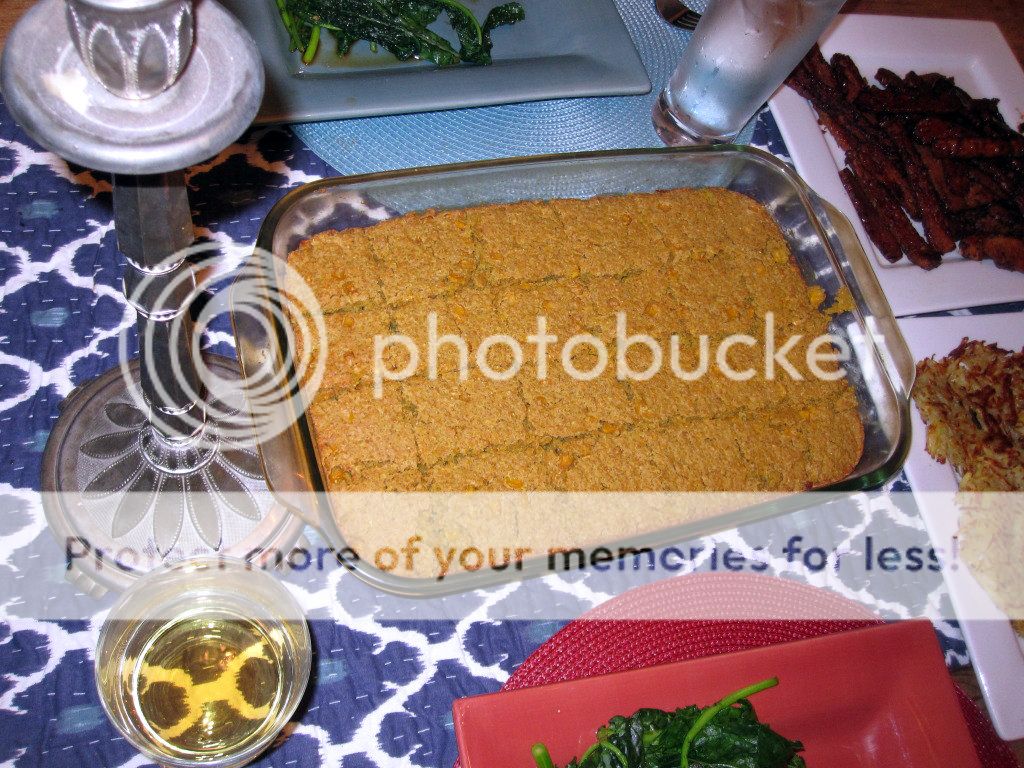
     Robert's brother, Clint, came to visit us at our new place in Boston over July 4th and had the excellent idea to celebrate the holiday with breakfast for dinner. I loved this idea because it allowed us to serve up lots of American classics with our own stamp of independence (read: everything was vegan). Another huge plus was that all our banging around in the kitchen and chatter drowned out most of the fireworks so Gubie had his very first non-suicidal July 4th. A revolutionary evening indeed!

QUINOA CORN BREAD
Ingredients:
1 cup quinoa
2 cups water
1 cup fresh corn kernels
1 1/4 cups cornmeal
1/3 cup spelt flour
1 tablespoon oat flour
1 tablespoon brown rice flour
1 1/4 tablespoons baking powder
1 teaspoon baking soda
1 teaspoon sea salt
1 tablespoon unrefined sugar
1 cup soy milk
1/3 cup maple syrup
1/3 cup unsweetened applesauce
1 tablespoon flax eggs (a fantastic egg substitute: place 2 parts warm water and 1 part ground flax seeds in a blender and blend at high speed for about a minute or until the mixture becomes gelatinous. Will keep, covered, in the refrigerator for up to 2 weeks.)

Instructions:
1. To make the quinoa, first toast quinoa on a dry pan over high heat for 2 minutes. Add 2 cups of water and bring to a boil. Reduce heat to low, cover, and simmer for 18-20 minutes until quinoa is fluffy.
2. Preheat oven to 350 degrees and get out a 13x9x2-inch baking pan.
3. In a large mixing bowl, combine the corn, cornmeal, flours, baking powder, baking soda, salt, and sugar. In a separate bowl, mix together the soy milk, maple syrup, applesauce, and flax eggs. Add the wet ingredients to the flour mixture and stir well to combine. Stir in the cooked quinoa. Pour the mixture into the prepared pan and bake for 30-35 minutes, or until a toothpick inserted in the center comes out clean.

DINER-STYLE PANCAKES
Ingredients:
1 1/4 cups sifted unbleached white or spelt flour (for gluten-free, use oat flour)
2 1/2 teaspoons baking powder
2 tablespoons unrefined sugar
3/4 teaspoons sea salt
1 1/2 teaspoons flax eggs (see corn bread recipe for instructions) dissolved in 1 tablespoon soy milk
1 3/4 cups soy milk
1/2 teaspoon vanilla extract
3 tablespoons canola oil, plus more for cooking the pancakes
maple syrup (optional)

Instructions:
1. In a large mixing bowl, combine the flour, baking powder, sugar, and salt. In a separate bowl, combine the dissolved flax eggs, soy milk, vanilla extract, and oil. Mix ingredients from both bowls together, stirring well to combine. 
2. In a large skillet over medium heat, heat some oil. Drop large spoonfuls of batter onto the skillet, leaving room for the pancakes to expand. Cook until the bottoms are golden and bubbles are popping on the surface, about 2-3 minutes. Flip the pancakes and cook until golden. Repeat, using up all the batter.

TEMPEH BACON + HASH BROWNS + HOMEMADE KETCHUP
I used Colleen Patrick-Goudreau's tempeh bacon recipe and used the remaining marinade to saute the greens. We served our homemade ketchup with the hash browns. Here's the recipe for the hash browns:

Ingredients:
3 lbs. yukon gold potatoes, grated
3 tablespoons canola oil
Salt and pepper to taste

Instructions:
1. Heat oil in a large frying pan over medium-high heat.
2. Add the grated potatoes in loose patties or piles, no more than a half inch think. Sprinkle some salt and pepper on top. After a few minutes, check the underside for doneness. Once they are golden brown, use a large spatula to flip the patty and fry till golden brown on the other side. Repeat with all patties.


RED, WHITE, AND BLUEBERRY CHEESECAKE
For this recipe I added blueberry frosting and fresh strawberries to my raw vegan cheesecake. Here's the recipe for the frosting:

Ingredients:
1 cup raw cashew pieces, soaked overnight
1 cup water
4 tablespoons agave syrup
1 teaspoon vanilla extract
1/4 cup coconut oil, melted
1 cup blueberries

Instructions:
1. Pulse the cashews in a food processor until crumbly. Add the water, agave, and vanilla and blend until smooth. With the food processor running, stream the coconut oil in through the top until combined. Add blueberries and puree till smooth.
2. Spread on top of the cheesecake with a spatula before putting in the freezer as instructed.

Dark Chocolate Coconut Cookies! Rawr!

     We love our oatmeal chocolate chip cookies but we wanted to mix it up a bit and have something that would make for a healthier pre-workout snack. Well, oh my lord, these are incredible! Wow! They taste just like moist brownies. But, believe it or not, they have very little added sugar and require no baking, and include the health-promoting ingredient maca, which means we can better justify indulging in several cookies on a daily basis.

Ingredients:
Makes about 18 cookies.
(Some of these ingredients may require a visit to a health food store or the "green" section of your supermarket. Or you can use the links I've provided and order the ingredients online. Trust me, these are so good, it's worth it!)
1/2 cup shredded coconut
2/3 cup coconut flour
4 tbsp cocoa powder
4 tsp maca powder
3 tbsp agave nectar
4 tbsp almond butter
1 tsp vanilla extract
12 large Medjool dates, pits removed
3/4 cup dark chocolate chips

Instructions:
1. Heat a small frying pan over low heat and add the coconut. Toast coconut until it has turned an amber color, about 1-2 minutes, stirring constantly. Remove from heat.
2. Place the toasted coconut, coconut flour, cocoa powder, maca, and agave into a food processor and start the machine.
3. Add the almond butter and vanilla extract, then one at a time, add the pitted dates and process until a crumbly dough has formed. The dough should be, well, doughy. Like a thick cookie dough. If too wet, add additional coconut flour. If too dry, add water, a little at a time, until optimal doughiness is achieved.
4. Transfer to a bowl and mix in the dark chocolate chips. Using clean hands, grab about a table spoon and squeeze and roll to form a tight ball. Flatten the ball using your palm to form a small cookie. You're welcome!