Showing posts with label Sides. Show all posts

eHow Video: Cornbread Dip

     I make the world's best cornbread. I'm not bragging; just stating a simple fact. (This fact has been verified numerous times by that Southern husband of mine.) In this dish, I've taken my cornbread recipe and transformed it into a dip! 
     This is a great example of how pureed beans can be used whenever you're in need of a creamy consistency. For this recipe, all I did was omit the flours I would normally use in my cornbread recipe, and used white beans instead. Between the beans and the quinoa, this dip is incredibly high in protein and fiber, while still maintaining the deliciously sweet tenderness of cornbread. Enjoy it with tortilla chips or carrot sticks. Yum!
Ingredients:
1 cup dry quinoa
1 cup cornmeal
1-15 oz can (or 1 1/2 cups) white beans, such as cannellini or navy beans
1 cup nondairy milk
3 tablespoons maple syrup
1 teaspoon chili powder
1/4 teaspoon cayenne
1 cup sweet corn

Instructions:
1. First prepare the quinoa: pour the quinoa onto a dry pan and toast over high heat for about 2 minutes, or until you start to hear popping. Add two cups of water and bring to a boil. Then, reduce the heat to low, cover, and continue cooking for 18-20 minutes. The quinoa is done when it's light and fluffy--similar to couscous--and each piece has a little curly tail.
2. In a food processor, combine the cornmeal, beans, nondairy milk, maple syrup, chili powder, and cayenne. Blend until smooth.
3. Add the corn and quinoa to the food processor and pulse till the consistency is smoother but still retains a graininess. 
4. Serve as is or heat up in the microwave for 1-3 minutes.

For my cornbread recipe, read on.

eHow Video: Dry Roasted Soybeans & Some Words on Soy Myths

     We all know that beans make a great dip or a great chili, but did you know they also make a great snack?
     You really could us apply this recipe to any type of bean but I think soybeans are just the perfect size and, frankly, this recipe really  hits the spot so I'm not too inclined to mess with it.
     Many roasted bean recipes will say olive oil is necessary to get the spices to stick onto the beans, but I find they spices stick just fine if the beans are wet, so I just add the spices right after I rinse the beans. This recipe calls for 1/2 teaspoon salt, which, if you are snacking with others, is pretty moderate but you are certainly free to use less or omit it entirely if you are on a low-sodium diet.
    Soybeans are incredibly nutritious. In fact, according to a recent research analysis, if Americans replaced their meat and dairy intake with soy, they would increase they intake of calcium, magnesium, iron, vitamin K, folate and fiber. But despite the plethora of scientific evidence about the health benefits of soy, there is still a lot of misinformation that continues to get passed around. I have heard some pretty extreme claims, everything from "I avoid soy because it causes dementia" to "Soy causes breast cancer" to "I don't let my son have soy because it will turn him into a girl." We've all heard claims like this, or perhaps we've even been the one doing the speaking. When we absorb or pass on these claims we are buying into and perpetuating a multimillion dollar anti-soy campaign sponsored by the meat and dairy industry.
     So here are some important myths about soy I wanted to debunk right off the bat to put your mind at ease.

Myth: "Soy causes dementia."
Reality: Soy does not cause dementia; in fact, it improves cognition. This myth seemed to originate from a study in which researchers found that tofu had harmful cognitive effects on people in Indonesia. However, the same was not true for tempeh, which is a more concentrated source of soy, so clearly soy itself was not the problem but something that was being added to the tofu. Well, guess what they use a preservative for tofu in Indonesia? Formaldedye! Yep, the same flammable human carcinogen that's used to make home industrial products. So next time someone tells you soy causes dementia, set the record straight and say that formaldedye might but soy certainly does not.
More info:
http://nutritionfacts.org/video/does-tofu-cause-dementia/

Myth: "Soy causes breast cancer."
Reality: This myth stems from the belief that soy has estrogen, and higher levels of estrogen have been linked to breast cancer. But soy doesn't even have estrogen! It has something called phytoestrogen, but this is not estrogen. Estrogen is a sex hormone that is found in all animals (including humans). Soy, in fact, is actually protective against breast cancer. It has been shown to reduce both the recurrence of and the risk of death from breast cancer.
More info:
http://nutritionfacts.org/video/brca-breast-cancer-genes-and-soy/
http://nutritionfacts.org/video/breast-cancer-survival-and-soy/
http://nutritionfacts.org/video/soy-breast-cancer-3/

Myth: "Soy gives men "man boobs."
Reality: Again, this probably stems from the confusion between estrogen and phytoestrogen. Soy has been shown to have no effect on a man's testosterone levels or circulating estrogen levels whatsoever. Also, if you are concerned about getting too much estrogen from soy but are still drinking breast milk from a 1,500 lb cow, I think you are barking up the wrong tree. Cows, like humans, only produce breast milk after giving birth. The demand for dairy means that a cow is essentially always pregnant so that she will always be producing milk. So those who consume dairy are consuming the milk from pregnant cows, which have a whole lot of estrogen. In fact, people who consume meat and dairy have significantly higher levels of estrogen in their blood. Definitely check out this study which examined what happens to men's hormone levels within in just one hour of consuming dairy (hint: their estrogen levels went up and their testosterone levels went down!).
More info:
http://www.fertstert.org/article/S0015-0282(10)00368-7

Myth: "All soy is GMO so it's poison." (I've actually heard this one verbatim.)
Reality: First of all, the largest consumer of GMO soy is farmed animals. In her article, "A Vegan Doctor Addresses Soy Myths and Misinformation", Holly Wilson, M.D. explains that this GMO soy "does not just magically evaporate in the slaughterhouse or milk processing plant. It ends up on your plate." Secondly, numerous brands of non-GMO tofu, tempeh, soy milk, and soy beans can be found in your grocery store labeled clearly on the package. These include Silk, Morinaga, and many others (see a comprehensive list here).

For more information debunking the misinformation about soy, read "Being Vegan and Eating Soy: Myths, Truths, and Everything In Between" by Christa Novelli M.P.H.
   
    So please, let yourself relax about soy and enjoy this delicious and healthful snack without a worry in the world. These crunchy and crispy little beans are so much fun to pop into your mouth. Be warned: they are quite addictive!
Ingredients:
2 cans of soybeans, drained and rinsed.
1 teaspoon chili powder
1 teaspoon cumin
1/2 teaspoon salt (optional)
1/2 teaspoon allspice
1/4 teaspoon cayenne

Instructions:
1. Preheat the oven to 400 degrees. In a medium bowl, toss the spices with the soybeans until evenly coated.
2. Spread the soybeans in one layer onto a tinfoil-lined baking sheet.
3. Roast the soybeans for 45-60 minutes, stirring every 20 minutes so they cook evenly.

eHow Video: Saucy Black Bean Dip

     This isn't just a healthy version of a your average black bean dip, which usually includes sour cream and dairy cheese. No, this dip is it's very own thing. The flavors are much richer and more complex, and it's not the least bit heavy. It has many ingredients found in traditional Mexican cuisine--such as black beans, chili powder, fire roasted tomatoes, and green chilies. But I have also added another ingredient that is bound to make your eyes go wide with delight when you first dig in. I'll give you two hints: 
     1) It's a very traditional ingredient in Mexican cooking (or from what is now Mexico), originating even before the Mayans. 
     2) It's from another bean.
     Any guesses?? 
     Cocoa powder! Yes, as in chocolate.
     Cocoa powder comes from beans from the cacao tree. (Actually, the word cocoa is believed to have its origins in a spelling mistake of the word cacao, so technically we should all be saying "cacao powder.") Cacao was first used for human enjoyment in Mexico, by a people called the Olmec, who lived prior to the Mayans' rise to power. So it is very traditional, indeed. (I find the history of food absolutely fascinating! If you want to learn more about the history of chocolate, see here.) 
     I don't use much cacao--just a teaspoon--but it adds so much to this dish. Whenever I test recipes, I usually make sure I leave some for Mr. Goldhouse to try so I can get his feedback. However, the first time I made this I didn't leave him a drop because it was just so good. I totally devoured it. So several days later I made it again, but the exact same thing happened! I had no idea that I could be so overcome by desire for a dip, but I seem to find this one completely irresistible. Fortunately, it's just pure, plant-based, whole food goodness without any added oil or salt, so aside from depriving Mr. Goldhouse, there was no reason to feel bad. 
     In fact, not only was there no reason to feel bad, there was every reason to feel good! Black beans are loaded with nutritional benefits. Here are just a few:
- Black beans are an excellent source of protein (just 1 cup has 15 grams), and it is far more healthful to get protein from plants rather than from animals. (See more info here.)
- Black beans are rich in soluble fiber which helps lower blood cholesterol levels. Lowered risk of coronary heart disease and heart attack risk have both been association with higher intake of soluble fiber, particularly beans.
-Black beans' contain both protein and fiber, a combination which helps keep blood sugar levels steady.
-Black beans contain an enormous amount of antioxidants and phytochemicals, so it should be no surprise that several studies have linked black bean consumption to a lowered risk of many cancers.
-Black beans are an excellent source of folate which is crucial for pregnant women as folate deficiency can cause defects in a fetus's brain and spinal cord.
-Black beans are a great source of iron.
    
     This dip is great with carrots or tortilla chips, but it also makes for a delicious sauce on brown rice, quinoa, or even pasta. 
Ingredients:
1 medium onion
2 cloves garlic
2 cups fire-roasted tomatoes
2 tablespoons green chilies
1 tablespoon chili powder
1 teaspoon unsweetened cocoa powder
1/2 teaspoon oregano
1/2 teaspoon cumin
1 1/2 cups cooked black beans
1 tablespoon chopped cilantro (optional)

Instructions:
1. Slice the onions and garlic. Saute them in a tablespoon of water until soft, about 5-7 minutes.
2. Add the tomatoes and seasonings. Stir for 5 minutes.
3. Reduce the heat to simmer and add the black beans. Cook for 10 minutes.
4. Transfer the sauce to a food processor or blender and puree to desired consistency (I like it to be a just little bit chunky).

eHow Video: "Filipino Eggplant Salad"

     "Ensaladang Talong" is a traditional Filipino eggplant salad that is typically made with shrimp paste and lots of white vinegar. One of the reasons for so much white vinegar is because it helps reduce the fishy taste of the shrimp paste and the fish this salad usually accompanies. That just seems silly to me, especially when you could just not use any shrimp paste and serve it with something other than fish. Personally, I want to taste the ingredients in my dishes. If something doesn't taste good and isn't serving any particular function, then why bother including it?
     In the recipe below, I show you how to prepare a fish-safe version of this salad. Since I wasn't using shrimp paste and, therefore, didn't need to worry about cutting any flavors, I used rice vinegar, which is milder and sweeter than white vinegar, and really enhances the tangy combination of the onion, tomatoes and chili.
     I like to make this salad and then enjoy it in a variety of ways over the next several days. Some of my favorites ways to eat it are with grilled tofu, tossed with garbanzo beans, or over a bed of brown rice. What might some of your favorite ways to enjoy this salad be?

Ingredients:
1 large eggplant
2 tomatoes, chopped
1 onion, chopped
1/2 teaspoon salt (optional; I prefer to omit)
1 slice red chili
3/4 cup rice wine vinegar
2 tablespoons low-sodium soy sauce or tamari
2-3 scallions

Instructions:
1. Prick the flesh of one large eggplant with a fork and roast at 100 degrees for 45 minutes. Once cool, peel the skin, cut the stem and mash lightly with a fork. 
2. In a bowl, combine two chopped tomatoes, one chopped onion, one half teaspoon salt and one slice of red chili. Add the eggplant and then toss to mix. 
3. To prepare the dressing, mix three quarter cup of wine vinegar, two tablespoons of soy sauce and some freshly ground pepper. Pour the dressing over the vegetables and mix and then garnish with some sliced scallions.

eHow Video: "Spanish Eggplant Salad" (Escalivada)

    I love Spain. In fact, I love it so much that I've been there four times. During my sophomore year of college I studied abroad for nearly six months in the fantastic city of Barcelona, the capital of the autonomous community of Catalonia. (Spain is broken up into 17 autonomous communities, each of which have their own unique characteristics and some even have their own distinct language.) 
     While as a whole, Spanish food is not nearly as revered as French or Italian food, Catalan food is considered some of the best the Mediterranean region has to offer. It's abundant in vegetables, rice dishes, beans, interesting tomato sauces, and nuts. Escalivada is a traditional Catalan dish that consists of roasted vegetables and lots of olive oil. In my recipe, I omit the olive oil and let the richness of the vegetables shine through. When roasted, the red onions and bell peppers become gloriously sweet, the tomatoes become slightly tart, and the eggplant becomes smoky. This is a great dish to have in your fridge because it just goes with everything. It's delicious on it's own as a salad, served along side rice or quinoa, or try blending it just a touch and then spread it on toasted bread.
   Bon profit! (Catalan) Buen provecho! (Spanish)
Ingredients:
1 large eggplant
1 medium red onion
2 medium tomatoes
1 red bell pepper
2 cloves garlic, smashed
1 tablespoon Sherry vinegar
1 teaspoon lemon juice
1/4 cup water
1-2 tablespoons parsley

Instructions:
1. Preheat the oven to 400 degrees.
2. Prick the eggplant with a fork and then place it, along with the onion, pepper and tomatoes on a tinfoil-lined baking sheet and put into the oven.
3. Remove the eggplant, tomatoes and peppers after 45 minutes and remove the onion after 60-75 minutes. (Make sure the eggplant is soft. If it still feels tough, keep cooking it and remove when you remove the onion.) 
4. To make the dressing, combine the garlic, Sherry vinegar, lemon juice and water. Add seasonings to taste.
5. Once the vegetables are cool enough to handle: Cut the eggplant into half-inch cubes. Peel and seed the peppers and cut them into wide strips. Peel and core the tomatoes and tear each into 4-5 pieces. Peel and remove the top and tail of the onion, then halve it lengthwise and cut it into half-inch strips.
6. Place all the vegetables in a large bowl and toss with the dressing. When ready to serve, top with 1-2 tablespoons of parsley. Enjoy at room temperature or cold.

eHow Video: "Southern-Style Mustard Greens"

     Mustard greens are so incredibly healthful, it was hard to decide which of their many benefits I ought to focus on in this post. Here are just three reasons why you'll want to incorporate more of these luscious leafies into your diet:

Cardiovascular Benefits
    Mustard greens support the cardiovascular system in three significant ways. First, they are anti-inflammatory. Inflammation narrows the arteries and increases the risk that they'll become blocked, so these anti-inflammatory properties are obviously a huge benefit. Second, by binding with bile acids in the intestines, mustard greens help lower cholesterol levels. And third, because mustard greens are exceptionally high in the B-vitamin folate, they help prevent homocystein build-up. Homocystein is an amino acid found in the blood that is acquired mostly from eating animal products. High levels are related to the development of heart and blood vessel disease.

Cancer Prevention
     Mustard greens are also powerful cancer-fighters because they are LOADED with a broad spectrum of antioxidants. Chronic oxidative stress is a major risk factor for the development of most cancer types and antioxidants lower our risk of oxidative stress on our cells (hence the name: anti- oxidants). For the record, plants have on average 64 times more antioxidant power than animal products. The few antioxidants that do happen to be found in animal products are only there because those animals were fed plants.

Bone Health
     And lastly (though I truly could go on endlessly), mustard greens are an excellent source of calcium. While dairy products have long been touted as "good for your bones," the countries with the highest consumption of dairy also have the highest rates of osteoporosis. This is because dairy, like all animal products, is highly acidic. The body needs to keep a very specific acid-alkaline balance in order to function, so whenever animal products are consumed, the body must find an alkaline source so it leaches the calcium from our bones (which is high in alkaline). So, in fact, consuming dairy products are quite harmful to our bones. Mustard greens, on the other hand, along with other greens like kale, collards, bok choy, broccoli, and okra, are not acidic and thus only contribute to the strength of our bones.

     So while you enjoy this quick and tasty recipe, you can also feel good knowing that you are eating one of the most healthful foods on the planet!

Ingredients:
1 large bunch mustard greens, chopped
1 small onion, chopped
3-6 cloves garlic (depending on your garlic preferences), chopped
1 teaspoon smoked paprika
1 teaspoon salt (optional)
1 teaspoon black pepper
1/4 cup water

Instructions:
1. In a cast iron pot, saute the onion until soft.
2. Add the garlic, smoked paprika, salt and pepper. Cook for 1 more minute, stirring constantly.
3. Add the mustard greens, and stir until they are coated with the spices and just wilted.
4. Add 1/4 cup of water and let simmer, covered, for about 5 minutes. Remove cover and cook for another 1-2 minutes.

Resources:
http://www.whfoods.com/genpage.php?tname=foodspice&dbid=93
http://www.vrg.org/nutrition/calcium.php
http://www.pcrm.org/health/health-topics/calcium-and-strong-bones

eHow Video: "How to Make Southern Candied Yams"

     Ladies and gentlemen, I present to you what may be the greatest side dish of all time!
     The first time I made this dish I ended up completely ignoring the main course and instead consumed all the yams.
     By myself.
     It was glorious.
     I will most definitely be making this dish for Thanksgiving this year and then again when we go down South to visit my in-laws over Christmas.
     Also, just to be totally honest here, when I say "yams" I actually mean "sweet potatoes." Don't be mad though, because when you say "yams" what you probably mean is "sweet potatoes" too. What we commonly refer to as a "yam" in the U.S. is actually a "sweet potato." Even in grocery stores, what are labeled "yams" are usually "sweet potatoes." The USDA has tried to crack down on this crazy scandal by requiring that sweet potatoes labeled "yams" include "sweet potatoes" in the label as well. That's why you'll often see "sweet potato yams." Both yams and sweet potatoes are nutritionally similar but sweet potatoes have a nutritional edge because they have much higher levels of vitamin A, vitamin B6, and vitamin C.
     While I usually don't cook with oil because it is a processed food without any fiber, sweet potatoes (aforementioned "yams") are one of those foods that benefits from being eaten with a small amount of fat. (Keyword here is "small," folks! I'm talking 1-2 tablespoons for an entire recipe.) The fat allows us to better absorb the beta carotene, an antioxidant that is critical for eye health, bone health, and reproductive health.
     Sweet potatoes really are a nutritional superstar, and they taste like a dessert. If that's not a win-win, then I don't know what is!

   
Ingredients:
2 1/2 lbs garnet yams or sweet potatoes, peeled and cut into 1/2-inch rounds
2 tablespoons toasted sesame oil
1 (2-inch) cinnamon stick
2 tablespoons molasses
1 teaspoon tamari (I prefer reduced-sodium)
2 tablespoons pure maple syrup
1 tablespoon white miso paste
2 tablespoons lemon juice
6 tablespoons water

Instructions:
1. Preheat the oven to 425 degrees.
2. In a large bowl, toss the sweet potatoes with 1 tablespoon of the sesame oil.
3. Spread the sweet potatoes onto a parchment-lined baking sheet in a single layer and roast for 25 minutes. Flip, and roast for another 25 minutes.
4. Place the cinnamon stick at the bottom of a 2-quart baking dish, and add the sweet potatoes in layers. Set aside.
5. In a medium-size bowl, whisk together the remaining six ingredients plus the remaining tablespoon of sesame oil and pour over the sweet potatoes.
6. Bake, uncovered, for 30 minutes.

eHow Video: "Roasted Root Vegetable Salad with Pumpkin Seeds"

     While this would, indeed, be a spectacular side salad for Thanksgiving, it almost seems unfair to make other dishes compete with this because it is such a star. Instead, I prefer to serve this hearty salad as an entree throughout the fall and winter months. For what it's worth, Mr. Goldhouse says this is easily THE best salad he's ever had, and one of the best dishes he's ever had. That is high praise, indeed!

     The roasted vegetables become as sweet as candy and because of their rich hues, it looks like you have gorgeous jewels on your plate. (For an even more bejeweled effect, add beets!) In addition to their beauty and deliciousness, root vegetables are also full of phytochemicals that help fight against cancer, diabetes, and heart disease.

Ingredients:
1 1/2 pound butternut squash
2 medium turnips or beets
2 medium parsnips
2 medium red onions
1 tablespoon fresh ginger
1 tablespoon maple syrup
1/2 teaspoon salt (optional)
1 tablespoon balsamic vinegar (more to taste)
fresh pepper, to taste
3-4 cups baby spinach
1/3 cup roasted pumpkin seeds (raw is fine too)

Instructions:
1. Preheat the oven to 450 degrees.
2. Peel all the vegetables and cut them into large chunks.
3. In a large bowl, toss the vegetables with the ginger, maple syrup, water, and salt if using.
4. Spread the vegetables in a roasting pan (I recommend lining it with parchment paper) and roast for 40-60 minutes, stirring half way through, until vegetables are very tender and caramelized. A good way to tell the vegetables are done is when the onions have lost all of their crunchiness and have become sweet.
5. Place the roasted vegetables on top of the baby spinach and top with pumpkin seeds. Season with balsamic vinegar and some fresh ground pepper to taste.

My eHow Video Series: Oven-Roasted Bell Peppers

     Bell peppers get their red, orange, and yellow color from carotenoids, which provide antioxidant and anti-inflammatory benefits that can help lower our risk of cancer development and heart disease. Bell peppers are also loaded with vitamin C, which supports our immune system. Given that they also taste fantastic, why wouldn't we want to make bell peppers a regular ingredient in our diet?
      In the video below, I show you how to roast bell peppers in the oven. As you'll see, it's quite simple. Roasting bell peppers really brings out their almost candy-like sweetness. I love to make salad dressings with pureed roasted bell peppers or blend them up with my hummus, but they are also delicious in a sandwich, on top of salad greens, or as a side dish. What's your favorite way to enjoy roasted bell peppers?

My eHow Video Series: Roasted Cauliflower With Mustard Butter

     Because cauliflower is white, people often assume it's a nutritional dud, on par with iceberg lettuce. But cauliflower is part of the cruciferous, or cabbage, family of vegetables. Other cruciferous vegetables include kale, bok choy, broccoli, and Brussels sprouts, which are more well-known as nutritional superstars. Cauliflower provides special nutrient support for the body's detox system, antioxidant system, and inflammatory/anti-inflammatory system, all of which are closely connected with cancer development and cancer prevention. There are numerous studies linking diets high in cauliflower to cancer prevention, particularly breast, bladder, colon, prostate, and ovarian cancers. In addition, cauliflower contains a wide array of antioxidants, which also helps to lower cancer risk.
     In this video, I demonstrate what is perhaps my favorite way to eat cauliflower. There is no butter, just a smooth and buttery consistency provided by the mix of mustards. Pop the florets into your mouth and enjoy it as fun appetizer, or serve it as a delicious side dish. Either way, it won't last long!
Ingredients:
1 (2 pound) head of cauliflower, cut into 1-inch florets

2 garlic cloves, chopped
1 teaspoon dried rosemary
1 teaspoon dried thyme
1 tablespoon dry white wine
2 tablespoons Dijon mustard
2 tablespoons whole-grain mustard
2 tablespoons water

Instructions:
1. Preheat the oven to 400 degrees F. Line a baking sheet with tinfoil. Set aside.
2. In a large bowl, mix sauce ingredients and stir until smooth. Add cauliflower and toss to coat.
3. Spoon the cauliflower evenly on the baking sheet.
4. Roast for 15-20 minutes until browned slightly. Transfer to a plate and serve.

My eHow Video Series: Light, Baked French Fries (Carrot Fries!)

     I absolutely adore carrots. I probably eat about 10 big carrots a day. Some might say I'm obsessed. I'm actually pretty sure the people at my food co-op think that because recently one of the cashiers said he was gathering up his nerve to ask me on behalf of himself and his co-workers why I buy so many. The answer? I just like them. A lot. They are so beautiful and so crunchy. Their flavor is earthy and complex, yet also delicate and subtle. And they are so versatile. I mean, you can eat them with everything! Why in the world people eat potato chips when they could be eating carrots is beyond me.
     And if you're wondering if my skin is orange, it's not. But I do have a healthier glow. Since beginning my mad love affair with carrots, I get asked all the time if I've just been on vacation because I look tan. In fact, this happens so frequently that my husband started getting jealous and now he juices carrots for breakfast. Ha! I eat mine whole, though. Because I am hard core like that.
     Anyway, back to this video. We all know that the best way to make French fries lighter is to bake them rather than fry them. But, can we go further? Is there a way to make baked French fries even more healthful?
     Why, yes! There is!
     Use carrots, of course!
     Because carrots are so sweet and flavorful on their own, you'll find that you don't really need to douse them with salt. And while you certainly could dip them in ketchup, you may not even want to because they taste so good on their own. This recipe is so simple, and it's obviously healthier alternative to traditional French fries. And needless to say, it is wonderfully delicious.

My eHow Video Series: Sesame Eggplant Dip Recipe

     In this video, I demonstrate my recipe for baba ghanouj, a Middle Eastern dish made with roasted eggplant and tahini. I am a huge eggplant fan, so baba ghanouj is naturally one of my favorite dishes in the world. If you like the flavor of hummus, you'll most likely love baba ghanouj. It's basically hummus's more exotic and dramatic big sister. Like hummus, there's lots of garlic, creaminess from tahini (sesame paste), earthy spices, and usually lots of olive oil.
      In my recipe, I omit the olive oil and rely on the tahini alone to provide the fat and butteriness, and you'll see it does the job just fine. I also leave the skin of the eggplant on, which is not typical of most baba ghanouj recipes, unfortunately. Eggplant skin is rich in nasunin, a potent antioxidant that protects cell membranes from damage.
     You can enjoy baba ghanouj with pita, veggies, spread on a sandwich or just by itself. Watch and I think you'll find it becomes a favorite of yours, too.
Ingredients:
1 large eggplants (totaling 2 lbs)
2-3 tablespoons roasted tahini (sesame paste)
1-2 garlic cloves, finely chopped
1 teaspoon ground cumin
2 ½ tablespoons lemon juice
Salt and cayenne pepper to taste
1 tablespoons chopped parsley 

Instructions:
1. Preheat oven to 400°F. Poke the eggplants in several places with a fork. Cut the eggplants in half lengthwise and place on a baking sheet, cut side down, and roast until very tender, about 35-40 minutes.
2. Remove from oven and allow to cool for 15 minutes.
3. Remove the eggplant skin and scoop flesh into a large bowl and mash well with a fork.
4. Combine the eggplant, minced garlic, tahini, garlic, cumin, lemon juice, the salt, and a pinch of cayenne. Mash well. You want the mixture to be somewhat smooth but still retaining some of the eggplant's texture.
5. Allow the baba ghanouj to cool to room temperature, then season to taste with additional lemon juice, salt, and cayenne. If you want, swirl a little olive oil on the top. Sprinkle with fresh chopped parsley. Serve with pita bread, crackers, toast, sliced baguette, celery, or cucumber slices.

My eHow Video Series: "Sauteed Spinach Without Butter or Oil"

     I recently finished filming an online video series, "Delicious Veggie Dishes," for eHow. There are 11 videos total, and in each one I cook up a delicious, healthful and easy recipe. I am so excited to share them! The entire series is now up on eHow, but I will be posting each video here one-by-one with some additional nutrition information.
     In the video below, I demonstrate how to saute spinach without adding the unnecessary calories and fat of butter or oil. Lest anyone think I am fat averse, notice that I top the spinach with pine nuts. This is because pine nuts are a whole food. In their whole state, high-fat plant foods such as nuts, seeds, avocados, and olives provide us with numerous health benefits. However, when we consume only the oils of these foods, most of these benefits are lost, leaving us with just pure artery-clogging fat and calories. Fortunately, swapping out butter or oil is quite easy, as you'll see.
    I hope you'll find watching these videos helpful and inspiring. Please feel free to leave feedback, ask questions, and share with others!

July 4th Vegan Breakfast-for-Dinner!

     Robert's brother, Clint, came to visit us at our new place in Boston over July 4th and had the excellent idea to celebrate the holiday with breakfast for dinner. I loved this idea because it allowed us to serve up lots of American classics with our own stamp of independence (read: everything was vegan). Another huge plus was that all our banging around in the kitchen and chatter drowned out most of the fireworks so Gubie had his very first non-suicidal July 4th. A revolutionary evening indeed!

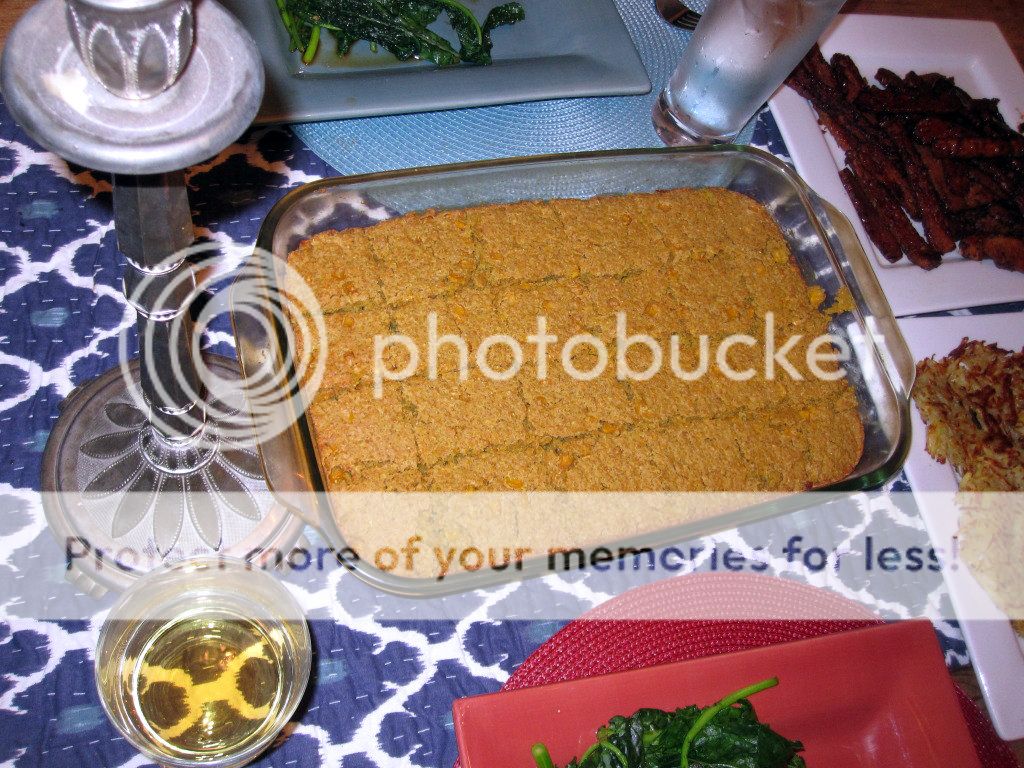
QUINOA CORN BREAD
Ingredients:
1 cup quinoa
2 cups water
1 cup fresh corn kernels
1 1/4 cups cornmeal
1/3 cup spelt flour
1 tablespoon oat flour
1 tablespoon brown rice flour
1 1/4 tablespoons baking powder
1 teaspoon baking soda
1 teaspoon sea salt
1 tablespoon unrefined sugar
1 cup soy milk
1/3 cup maple syrup
1/3 cup unsweetened applesauce
1 tablespoon flax eggs (a fantastic egg substitute: place 2 parts warm water and 1 part ground flax seeds in a blender and blend at high speed for about a minute or until the mixture becomes gelatinous. Will keep, covered, in the refrigerator for up to 2 weeks.)

Instructions:
1. To make the quinoa, first toast quinoa on a dry pan over high heat for 2 minutes. Add 2 cups of water and bring to a boil. Reduce heat to low, cover, and simmer for 18-20 minutes until quinoa is fluffy.
2. Preheat oven to 350 degrees and get out a 13x9x2-inch baking pan.
3. In a large mixing bowl, combine the corn, cornmeal, flours, baking powder, baking soda, salt, and sugar. In a separate bowl, mix together the soy milk, maple syrup, applesauce, and flax eggs. Add the wet ingredients to the flour mixture and stir well to combine. Stir in the cooked quinoa. Pour the mixture into the prepared pan and bake for 30-35 minutes, or until a toothpick inserted in the center comes out clean.

DINER-STYLE PANCAKES
Ingredients:
1 1/4 cups sifted unbleached white or spelt flour (for gluten-free, use oat flour)
2 1/2 teaspoons baking powder
2 tablespoons unrefined sugar
3/4 teaspoons sea salt
1 1/2 teaspoons flax eggs (see corn bread recipe for instructions) dissolved in 1 tablespoon soy milk
1 3/4 cups soy milk
1/2 teaspoon vanilla extract
3 tablespoons canola oil, plus more for cooking the pancakes
maple syrup (optional)

Instructions:
1. In a large mixing bowl, combine the flour, baking powder, sugar, and salt. In a separate bowl, combine the dissolved flax eggs, soy milk, vanilla extract, and oil. Mix ingredients from both bowls together, stirring well to combine. 
2. In a large skillet over medium heat, heat some oil. Drop large spoonfuls of batter onto the skillet, leaving room for the pancakes to expand. Cook until the bottoms are golden and bubbles are popping on the surface, about 2-3 minutes. Flip the pancakes and cook until golden. Repeat, using up all the batter.

TEMPEH BACON + HASH BROWNS + HOMEMADE KETCHUP
I used Colleen Patrick-Goudreau's tempeh bacon recipe and used the remaining marinade to saute the greens. We served our homemade ketchup with the hash browns. Here's the recipe for the hash browns:

Ingredients:
3 lbs. yukon gold potatoes, grated
3 tablespoons canola oil
Salt and pepper to taste

Instructions:
1. Heat oil in a large frying pan over medium-high heat.
2. Add the grated potatoes in loose patties or piles, no more than a half inch think. Sprinkle some salt and pepper on top. After a few minutes, check the underside for doneness. Once they are golden brown, use a large spatula to flip the patty and fry till golden brown on the other side. Repeat with all patties.


RED, WHITE, AND BLUEBERRY CHEESECAKE
For this recipe I added blueberry frosting and fresh strawberries to my raw vegan cheesecake. Here's the recipe for the frosting:

Ingredients:
1 cup raw cashew pieces, soaked overnight
1 cup water
4 tablespoons agave syrup
1 teaspoon vanilla extract
1/4 cup coconut oil, melted
1 cup blueberries

Instructions:
1. Pulse the cashews in a food processor until crumbly. Add the water, agave, and vanilla and blend until smooth. With the food processor running, stream the coconut oil in through the top until combined. Add blueberries and puree till smooth.
2. Spread on top of the cheesecake with a spatula before putting in the freezer as instructed.

Thanksgiving!


Menu
Shredded Brussels Sprouts with Toasted Pecans and Dried Cranberries
Garlic-Herb Mashed Potatoes and Cauliflower
Wild Mushroom Gravy
Quinoa Corn Bread
Tamarind BBQ Tempeh and Sweet Potatoes
Pumpkin-Pecan Praline Cheesecake


Beet Burgers + Fries + Homemade Ketchup!

     You CAN enjoy delicious comfort food while also being comforted by the abundance of cancer-fighting, eyesight-promoting, and heart-supporting nutrients in this truly happy meal.

Ingredients:
For burgers:
2 large beets
2 cups cooked quinoa
1 cup toasted sunflower seeds
1/2 cup toasted sesame seeds
1 small onion
1/4 cup oil
3 tablespoon finely chopped fresh parsley
4 cloves garlic, finely chopped
3 tablespoons tamari/soy sauce
1/4 teaspoon cayenne pepper
1 tablespoon ground flax seed
3 tablespoon water

For fries:
2 large sweet potatoes
1 tablespoon oil
1 teaspoon salt
Freshly ground pepper
1/2 teaspoon ground cumin

For ketchup:
2 tablespoons olive oil
1 medium yellow onion, chopped
3 lbs. ripe tomatoes, cored and chopped
1/2 cup packed dark brown sugar
1/4 cup apple cider vinegar
1 teaspoon salt
1 teaspoon dry mustard
1/2 teaspoon celery salt
1/2 teaspoon garlic powder
1/4 teaspoon ground cloves
1/4 teaspoon allspice

Instructions:
For burgers:
1. Preheat the oven to 350 degrees.
2. In a large bowl, combine the grated beets, quinoa, sunflower seeds, sesame seeds, onion, oil, parsley, garlic, tamari, and cayenne. Add salt to taste.
3. In a separate bowl mix, the flax seed and water until thick and gelatinous. Stir into the beet mixture.
4. Begin to form uniform-size patties (aim for about 12). If they are falling apart, create more of the flax seed and water mixture to add in.
5. Bake for 25 minutes, or until firm. Carefully flip halfway during the cooking time.
6. Suggested burger toppings: avocado slices, grilled red onions, sliced tomatoes, and Follow Your Heart's Vegenaise (a delicious eggless--and thus, much healthier--mayonnaise).

For fries:
1. Preheat the oven to 400 degrees. In a small bowl, combine the cumin, salt, and pepper. Set aside.
2. Cut sweet potatoes in half lengthwise, and then each half into six slices.
3. In a large bowl, combine the sliced potatoes, oil, and spice mixture. Toss until the potatoes are evenly coated.
4. On a baking sheet, arrange the potatoes in a single layer. Bake until edges begin to crisp, about 40 minutes.

For ketchup:
1. Add olive oil to a large saucepan over medium-low heat. Add the chopped onions and cook, stirring, until the onions are soft but not brown, about 10 minutes.
2. Add the chopped tomatoes (including all juice and seeds), brown sugar, vinegar, salt, dry mustard, celery salt, garlic powder, ground cloves, and allspice to the onions. Stir well to combine.
3. Bring the mixture to a boil and then reduce the heat to a simmer. Cook uncovered, stirring occasionally, until most of the liquid has evaporated, about 1 hour 15 minutes.
4. Allow the mixture to cook slightly, then place into a blender. Puree for about 1 minute, or until completely smooth.
5. Taste and add more salt if desired. Pour the mixture into an airtight container and keep in the refrigerator for up to 3 weeks. Serve chipped or at room temperature. Yum!!

Sources: Recipes inspired from Color Me Vegan and Susan Odell; See health benefits of sweet potatoes, beets, tomatoes, and avocados

Kale Chips

     For those of us who have a tendency to eat an entire extra-large bag of tortilla chips in a single day (ahem, Robert), kale chips are a delicious and healthy alternative. Nutritional yeast (the yellow flakes sprinkled on top of the kale) has become our new best friend. It has a delicious cheesy flavor and is a reliable source of vitamin B12. Try some sprinkled on popcorn, tossed with pasta, or stirred into a salad dressing.

Ingredients:
1. 1 bunch curly or Lacinato kate
2. 1-2 teaspoons olive oil
3. Pinch of salt
4. 2 tablespoons nutritional yeast, plus more to taste

Instructions:
1. Preheat the oven to 400 degrees. Tear or cut the kale leaves away from the thick stems and then into bite-size pieces. Wash and thoroughly dry the leaves.
2. Transfer the kale to a large bowl and drizzle with the olive oil, sprinkle with the salt, and add the nutritional yeast. Toss the leaves until fully coated.
3. Lay the leaves out on a baking sheet in a single layer (no overlapping!), sprinkle them with more nutritional yeast to taste, and bake until the leaves are crisp but not burnt, 10-15 minutes, checking every 5 minutes or so.

Golden Rice with Curried Apricot Dressing

     This dish is similar to paella but it has more sweetness in flavor. The apricot dressing is loaded with richness and spice, and makes the whole rice mixture really creamy. This recipe could easily satisfy 4 people, but keep in mind that before we started eating we were certain there would be leftovers but it was so good that we didn't want to stop eating. But hey, that's another great thing about eating a plant-based, whole foods diet-- it's all good-for-you stuff, so helping yourself to seconds (and thirds and fourths) is fine!

Update: I tried adding a can of chickpeas to this dish and really enjoyed it. It's delicious either way, but I now prefer it with the chickpeas.

Ingredients:
1 tablespoon water or vegetable stock, for sauteing
1 medium sweet yellow onion, finely diced
2 cloves garlic, minced
1 teaspoon ground cumin
1 teaspoon fennel seed
1/4 teaspoon freshly ground pepper
1/2 teaspoon salt, or to taste
2 cups uncooked brown basmati rice
2 teaspoons turmeric
3 1/2 cups vegetable stock
3 large carrots, peeled and chopped
1 tart apple, diced and tossed with lemon juice
3 scallions, thinly sliced
Curried Apricot Dressing
1/4 cup apricot preserves
1/3 cup rice vinegar
1 tablespoon curry powder
1/4 teaspoon ground cardamom
1/4 teaspoon cayenne pepper
2/3 cup water

Instructions:
1. In a medium saucepan, heat the water or stock over medium heat and saute the onion and garlic until just softened, about 5 minutes.
2. Add the cumin, fennel seed, pepper, and salt. Saute for 1 minute.
3. Add the rice and stir constantly for 2 minutes or until the rice smells fragrant.
4. Add the turmeric and the 3 1/2 cups vegetable stock. bring to boil and cover.
5. Reduce heat to low and simmer for 40-45 minutes or until the liquid is absorbed.
6. Meanwhile, to make the dressing combine all the ingredients in a blender or food processor and blend until emulsified. Taste and adjust the seasonings.
7. After step 5 is done, remove the pan from heat and add the carrots, apple, and scallions. Stir so everything is all mixed in and then transfer to a large serving bowl.
8. Pour most of the dressing onto the rice and mix thoroughly. Taste and add the rest of the dressing, if desired, or reserve for another use. Serve, savor, and enjoy!

Source: This is based on a recipe from Colleen Patrick-Goudreau's "Color Me Vegan". (Her recipe calls for saffron, which I had planned to use but forgot to purchase. I used turmeric instead and we loved how it turned out so I'll continue to make this dish with turmeric in the future. I also omitted the oil.) 

Brussels Sprouts + Apples + Pecans

     Brussels Sprouts are so cute! They are also really nutritious, boasting high amounts of vitamins C and K, and containing an abundance of disease-fighting phytochemicals, including sulforaphane, which helps rid the body of carcinogenic substances.
     This dish was inspired by a recipe in "Color Me Vegan" by Colleen Patrick-Goudreau. I absolutely LOVE this cookbook and I think the author is awesome. Her podcast Vegetarian Food for Thought (which you can listen to for free) is so inspiring and informative. Not only is she well-versed in nutrition--which is why I started listening to her in the first place--but she also has helped me see that our food choices can be, and should be, an extension of who we are and what we value in life. It's such an empowering outlook. Her words have really broadened my perspective.